document.addEventListener('DOMContentLoaded', function() { const items = document.querySelectorAll('.publication-item'); items.forEach(item => { const url = item.textContent.trim(); // get the URL from the div if(url){ item.addEventListener('click', function(e){ e.preventDefault(); // stop the default post page link e.stopPropagation(); // stop outer click window.location.href = url; // redirect to external URL }); } }); }); Skip to main content

The Andes

Languages, Origins and (Pre)History

Tres Cruces
Symposia

Symposia

An ongoing series of conferences and symposia, uniquely interdisciplinary to bring together archaeologists, geneticists, linguists, historians, anthropologists and climatologists, for a more holistic view of the (pre)history of the civilisation of the Andes.
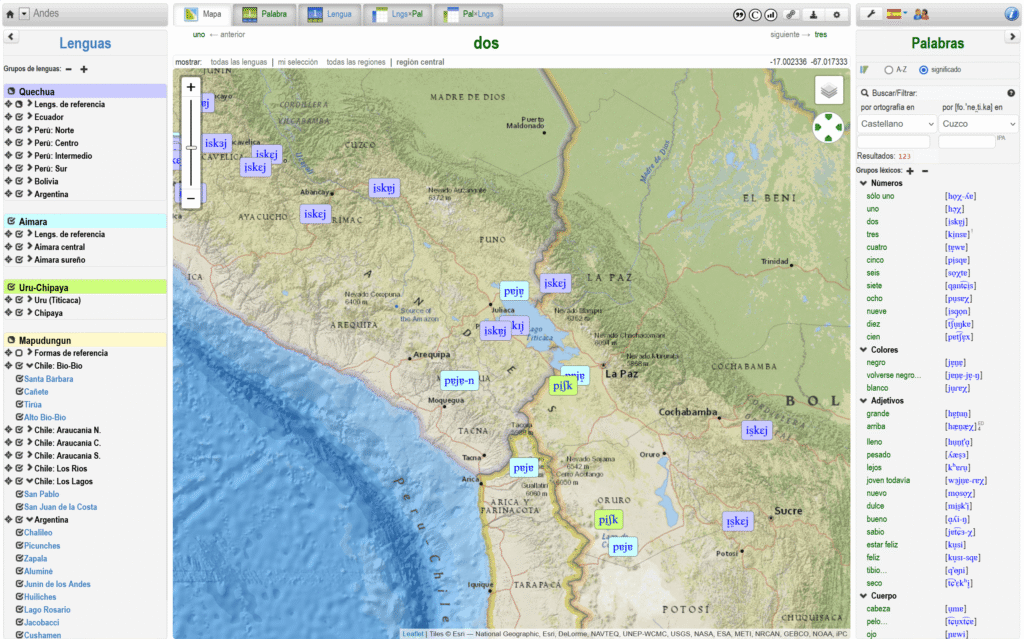
Sound Comparisons: Andes

Sound Comparisons: Andes

Explore the sounds of the Andean languages, listen to how the same words are pronounced differently from Ecuador to Argentina. Thousands of word recordings and transcriptions in Quechua, Aymara and Uru, from over thirty years of fieldwork.
Quechua

Quechua

Quechua is the greatest surviving legacy of the languages of indigenous Americas. It is the language of Machu Picchu, and crucial to understanding the prehistory of the Andes.
The Mapuche

The Mapuche

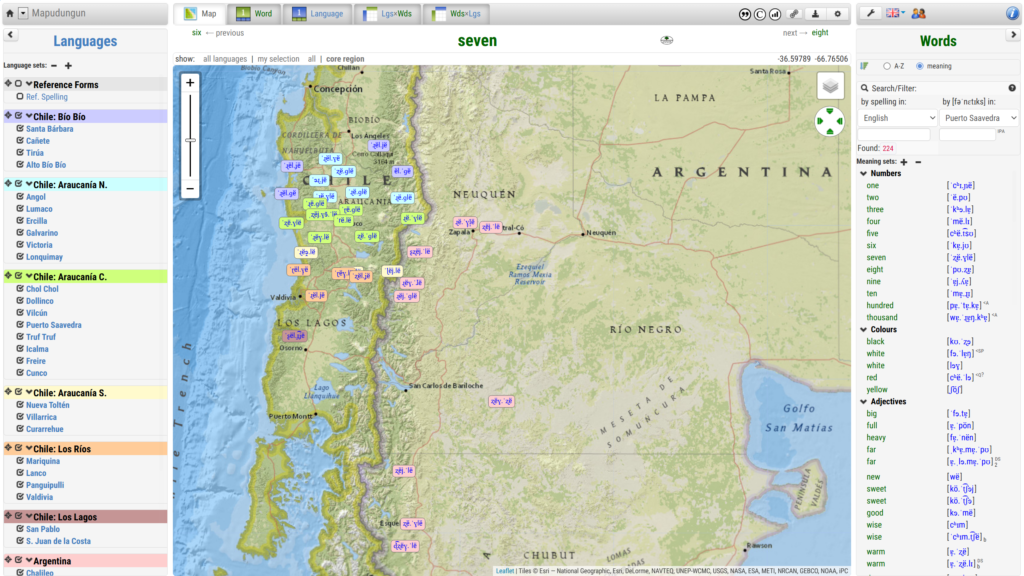
The last major surviving indigenous people in southernmost South America are the Mapuche of Patagonia. I research their genetic origins, and created the Sound Comparisons: Mapudungun resource to explore regional diversity within their unique but endangered isolate language, Mapudungun.

Why the Andes?

The Andes are unique in the human story — one of the world’s few hearths where farming and a pristine civilisation arose, and here in isolation from all others.  This made for a natural experiment in history, played out in an ecological context that is likewise unique.  Nowhere else on Earth does ecology transform so swiftly and utterly as where the Andes rise out of a desert coast to over 6000m, then plunge back down to rainforest in Amazonia.  And here in the Tropics, from arid west to humid east, this transect races through a panoply of ecologies, liveable here even up to 5000m.
The fascination of the Andes runs back through many millennia of prehistory.  From the mesmerising stonework of the Incas to the Nazca lines a thousand years earlier, and all the way back to the first monuments and cities of the Americas, on Peru’s desert coast, that broke the mould of how civilisation arose elsewhere.  In Peru itbegan not out of farming but out of foraging, hunting and fishing in the teeming waters of the Pacific.  A crucial early crop was … cotton, not to eat but to make fish nets.  Even the Incas ran one of the greatest world empires not with writing but with textiles (knotted khipu), and without iron, horses or the wheel.
My three decades of research here began from another dimension of Andean culture:  their native languages, above all Quechua, Aymara and Mapudungun, in fieldwork from Ecuador to Patagonia.  Today, some 7 million people still speak Quechua, the greatest surviving legacy of the speech of the entire Americas from before European conquest.  The language of Machu Picchu (‘old peak’) and of the last Inca emperors can still be heard, but is increasingly threatened.  And its diversity and origins tells an unsuspected new story, to challenge and enrich what we thought we knew of the Andean past.
Quechua goes back long before the Incas, to earlier cultures who together created Peru’s unparalleled archaeological record.  But which of them spread Quechua so spectacularly — when, where and how?  And from Colombia to Argentina, how did Quechua come to be spoken by people whose genetic origins, however, bear little or no trace of Cuzco.  Archaeologists, geneticists, historians and linguists have had a great deal to learn from each other, over ten uniquely cross-disciplinary conferences and symposia and four books that I have convened and edited since 2008.  By fomenting a meeting of minds between us, we hope to come together towards a new, fully coherent and holistic understanding of the astonishing prehistory of the Andes.
ImageLinkPublication Details     [count = 43]TypeAuthor-Date
-

Heggarty, P., & Epps, P. in press.
Language lessons on the prehistory of South America.
in: Aldenderfer, M., M. Sepulveda, & E.G. Neves (eds)
Handbook of South American Archaeology.
Oxford: Oxford University Press.

Book Section
URL

Heggarty, P., & Epps, P. 2026a.
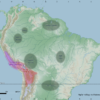
Map of Major Language Families of South America: Heggarty & Epps 2026 – Figure 1.
Zenodo.
https://doi.org/10.5281/zenodo.15075188

Artwork
URL

Heggarty, P., & Epps, P. 2026b.
Map of Notable Linguistic Convergence Areas within South America: Heggarty & Epps 2026 – Figure 2.
Zenodo.
https://doi.org/10.5281/zenodo.15075425

Artwork
URL

Heggarty, P. 2024.
Expansions and language shift in prehistory.
in: Urban, M. (ed)
The Oxford Guide to the Languages of the Central Andes, p.683–724.
Oxford: Oxford University Press.
https://doi.org/10.13140/RG.2.2.10823.78241 https://doi.org/10.1093/oso/9780198849926.003.0023

Book Section
URL

Arango-Isaza, E., Capodiferro, M.R., Aninao, M.J., Babiker, H., Aeschbacher, S., Achilli, A., Posth, C., Campbell, R., Martínez, F.I., Heggarty, P., Sadowsky, S., Shimizu, K.K., & Barbieri, C. 2023.
The genetic history of the Southern Andes from present-day Mapuche ancestry.
Current Biology 33 (13): p.2602-2615.e5.
https://doi.org/10.1016/j.cub.2023.05.013

Journal Article
URL

Heggarty, P. 2020a.
Linguistics: How languages can inform on the Andes-Amazonia divide.
in: Pearce, A.J., D.G. Beresford-Jones, & P. Heggarty (eds)
Rethinking the Andes-Amazonia Divide, p.35–47.
London: UCL Press.
https://doi.org/10.2307/j.ctv13xps7k.10

Book Section
URL

Heggarty, P. 2020b.
Deep time and first settlement: what, if anything, can linguistics tell us?.
in: Pearce, A.J., D.G. Beresford-Jones, & P. Heggarty (eds)
Rethinking the Andes-Amazonia Divide, p.94–102.
London: UCL Press.
https://doi.org/10.2307/j.ctv13xps7k.16

Book Section
URL

Heggarty, P. 2020c.
Broad-scale patterns across the languages of the Andes and Amazonia.
in: Pearce, A.J., D.G. Beresford-Jones, & P. Heggarty (eds)
Rethinking the Andes-Amazonia Divide, p.164–77.
London: UCL Press.
https://doi.org/10.2307/j.ctv13xps7k.22

Book Section
URL

Pearce, A.J., Beresford-Jones, D.G., & Heggarty, P. 2020a.
Rethinking the Andes-Amazonia Divide.
London: UCL Press.
https://doi.org/10.14324/111.9781787357358

Book
URL

Pearce, A.J., Beresford-Jones, D.G., & Heggarty, P. 2020b.
Introduction: Why Andes–Amazonia? Why cross- disciplinary?.
in: Pearce, A.J., D.G. Beresford-Jones, & P. Heggarty (eds)
Rethinking the Andes-Amazonia Divide, p.1–18.
London: UCL Press.
https://doi.org/10.2307/j.ctv13xps7k.8

Book Section
URL

Pearce, A.J., Beresford-Jones, D.G., & Heggarty, P. 2020c.
Conclusion. The Andes–Amazonia divide: Myth and reality.
in: Pearce, A.J., D.G. Beresford-Jones, & P. Heggarty (eds)
Rethinking the Andes-Amazonia Divide, p.332–8.
London: UCL Press.
https://doi.org/10.2307/j.ctv13xps7k.34

Book Section
URL

Barbieri, C., Barquera, R., Arias, L., Sandoval, J.R., Acosta, O., Zurita, C., Aguilar-Campos, A., Tito-Álvarez, A.M., Serrano-Osuna, R., Gray, R.D., Mafessoni, F., Heggarty, P., Shimizu, K.K., Fujita, R., Stoneking, M., Pugach, I., & Fehren-Schmitz, L. 2019.
The Current Genomic Landscape of Western South America: Andes, Amazonia, and Pacific Coast.
Molecular Biology and Evolution.
https://doi.org/10.1093/molbev/msz174

Journal Article
URL

Barbieri, C., Sandoval, J.R., Valqui, J., Shimelman, A., Ziemendorff, S., Schröder, R., Geppert, M., Roewer, L., Gray, R., Stoneking, M., Fujita, R., & Heggarty, P. 2017.
Enclaves of genetic diversity resisted Inca impacts on population history.
Scientific Reports 7 (1): p.17411.
https://doi.org/10.1038/s41598-017-17728-w

Journal Article
URL

Heggarty, P. 2015a.
La riqueza idiomática de los Andes [= Language diversity in the Andes].
Investigación y Ciencia [= Spanish edition of Scientific American] 460: p.36–41.
https://www.academia.edu/12448905

Journal Article
-

Sadowsky, S., Aninao, M.J., Cayunao, M.I., & Heggarty, P. 2015.
Huilliche: ¿geolecto del mapudungun o lengua propia? Una mirada desde la fonética y la fonología de las consonantes.
in: Fernández Garay, A. & M.A. Regúnaga (eds)
Lingüística indígena sudamericana: aspectos descriptivos, comparativos y areales.
Buenos Aires: Editorial de la Facultad de Filosofía y Letras, Universidad de Buenos Aires.

Book Section
URL

Barbieri, C., Heggarty, P., Yang Yao, D., Ferri, G., de Fanti, S., Sarno, S., Ciani, G., Boattini, A., Luiselli, D., & Pettener, D. 2014.
Between Andes and Amazon: The genetic profile of the Arawak-speaking Yanesha.
American Journal of Physical Anthropology 155 (4): p.600–9.
https://doi.org/10.1002/ajpa.22616

Journal Article
URL

Heggarty, P., & Renfrew, C. 2014f.
The Americas: Languages.
in: Renfrew, C. & P. Bahn (eds)
The Cambridge World Prehistory, p.1316–43.
Cambridge: Cambridge University Press.
https://doi.org/10.1017/CHO9781139017831.084

Book Section
URL

Heggarty, P. 2014b.
Sprachenvielfalt der Anden [= Language diversity in the Andes].
Spektrum der Wissenschaft 2014 (06): p.68–73.
https://spektrum.de/alias/1281878

Journal Article
URL

Beresford-Jones, D.G., & Heggarty, P. 2013.
Andes: archaeology.
in: Ness, I. & P. Bellwood (eds)
The Encyclopedia of Global Human Migration, p.410–6.
Oxford: Wiley-Blackwell.
https://doi.org/10.1002/9781444351071.wbeghm853

Book Section
URL

Heggarty, P., & Beresford-Jones, D.G. 2013.
Andes: linguistic history.
in: Ness, I. & P. Bellwood (eds)
The Encyclopedia of Global Human Migration, p.401–9.
Oxford: Wiley-Blackwell.
https://doi.org/10.1002/9781444351071.wbeghm852

Book Section
URL

Beresford-Jones, D.G., & Heggarty, P. 2012a.
Introduction: Archaeology, linguistics, and the Andean past — a much-needed conversation.
in: Heggarty, P. & D.G. Beresford-Jones (eds)
Archaeology and Language in the Andes, Proceedings of the British Academy, p.1–41.
Oxford: Oxford University Press.
http://fdslive.oup.com/www.oup.com/academic/pdf/13/9780197265031_prelim.pdf

Book Section
URL

Beresford-Jones, D.G., & Heggarty, P. 2012b.
Broadening our horizons: towards an interdisciplinary prehistory of the Andes.
in: Heggarty, P. & D.G. Beresford-Jones (eds)
Archaeology and Language in the Andes, Proceedings of the British Academy, p.57–84.
Oxford: Oxford University Press.
https://doi.org/10.5871/bacad/9780197265031.003.0003

Book Section
URL

Heggarty, P., & Beresford-Jones, D.G. 2012a.
Archaeology and Language in the Andes.
Oxford: Oxford University Press.
https://doi.org/10.5871/bacad/9780197265031.001.0001

Book
URL

Heggarty, P., & Beresford-Jones, D.G. 2012b.
Conclusion — A cross-disciplinary prehistory for the Andes? Surveying the state of the art.
in: Heggarty, P. & D.G. Beresford-Jones (eds)
Archaeology and Language in the Andes, Proceedings of the British Academy, p.409–36.
Oxford: Oxford University Press.
https://doi.org/10.5871/bacad/9780197265031.016.0016

Book Section
URL

Heggarty, P. 2012a.
Beyond lexicostatistics: How to get more out of ‘word list’ comparisons.
in: Wichmann, S. & A.P. Grant (eds)
Quantitative Approaches to Linguistic Diversity: Commemorating the Centenary of the Birth of Morris Swadesh, [Reprint of Diachronica 27 (2), from 2010], p.113–37.
Amsterdam: John Benjamins.
https://doi.org/10.1075/bct.46.07heg

Book Section
URL

Barbieri, C., Heggarty, P., Castrì, L., Pettener, D., & Luiselli, D. 2011.
Mitochondrial DNA variability in the Titicaca basin: matches and mismatches with linguistics and ethnohistory.
American Journal of Human Biology 23: p.89–99.
https://doi.org/10.1002/ajhb.21107

Journal Article
URL

Beresford-Jones, D.G., & Heggarty, P. 2011a.
What role for language prehistory in redefining archaeological ‘culture’? A case-study on new horizons in the Andes.
in: Roberts, B. & M. Vander Linden (eds)
Investigating Archaeological Cultures: Material Culture, Variability and Transmission, p.355–86.
New York: Springer.
https://doi.org/10.1007/978-1-4419-6970-5_17

Book Section
URL

Beresford-Jones, D.G., & Heggarty, P. 2011b.
Broadening our horizons: towards an interdisciplinary prehistory of the Andes.
in: Kaulicke, P., R. Cerrón-Palomino, P. Heggarty, & D.G. Beresford-Jones (eds)
Lenguas y sociedades en el antiguo Perú: hacia un enfoque interdisciplinario, Boletín de Arqueología PUCP, p.61–84.
Lima: Fondo Editorial de la Pontificia Universidad Católica del Perú.
http://revistas.pucp.edu.pe/index.php/boletindearqueologia/article/download/1184/1143

Book Section
URL

Heggarty, P., & Beresford-Jones, D.G. 2011.
Archaeology, language, and the Andean past: principles, methods, and the new ‘state of the art’.
in: Kaulicke, P., R. Cerrón-Palomino, P. Heggarty, & D.G. Beresford-Jones (eds)
Lenguas y sociedades en el antiguo Perú: hacia un enfoque interdisciplinario, Boletín de Arqueología PUCP, p.29–60.
Lima: Fondo Editorial de la Pontificia Universidad Católica del Perú.
http://revistas.pucp.edu.pe/index.php/boletindearqueologia/article/download/1181/1142

Book Section
URL

Heggarty, P., & Pearce, A. 2011.
History and Language in the Andes.
London: Palgrave Macmillan.
https://doi.org/10.1057/9780230370579

Book
URL

Heggarty, P. 2011.
Enterrando el esqueleto quechumara.
in: Adelaar, W.F.H., P. Valenzuela, & R. Zariquiey (eds)
Estudios sobre lenguas andinas y amazónicas. Homenaje a Rodolfo Cerrón-Palomino, p.147–79.
Lima: Fondo Editorial de la PUCP.
https://doi.org/10.18800/9789972429729

Book Section
URL

Kaulicke, P., Cerrón-Palomino, R., Heggarty, P., & Beresford-Jones, D.G. 2011.
Lenguas y sociedades en el antiguo Perú: hacia un enfoque interdisciplinario.
Lima: Fondo Editorial de la Pontificia Universidad Católica del Perú.
https://revistas.pucp.edu.pe/index.php/boletindearqueologia/issue/view/220

Book
URL

Pearce, A.J., & Heggarty, P. 2011a.
History, linguistics, and the Andean past: a much-needed conversation.
in: Heggarty, P. & A.J. Pearce (eds)
History and Language in the Andes, p.1–16.
London: Palgrave Macmillan.
https://doi.org/10.1057/9780230370579_1

Book Section
URL

Pearce, A.J., & Heggarty, P. 2011b.
Mining the data on the Huancayo-Huancavelica Quechua frontier.
in: Heggarty, P. & A.J. Pearce (eds)
History and Language in the Andes, p.87–109.
London: Palgrave Macmillan.
https://doi.org/10.1057/9780230370579_5

Book Section
URL

Heggarty, P., & Beresford-Jones, D.G. 2010.
Agriculture and language dispersals: limitations, refinements, and an Andean exception?.
Current Anthropology 51 (2): p.163–91.
https://doi.org/10.1086/650533

Journal Article
URL

Heggarty, P. 2010.
Beyond lexicostatistics: How to get more out of ‘word list’ comparisons.
Diachronica 27 (2): p.301–24.
https://doi.org/10.1075/dia.27.2.07heg

Journal Article
URL

Heggarty, P., & Beresford-Jones, D.G. 2009.
Not the Incas? Weaving archaeology and language into a single new prehistory.
British Academy Review 12: p.11–5.
https://www.thebritishacademy.ac.uk/sites/default/files/04-heggarty.pdf

Journal Article
URL

Heggarty, P. 2008.
Linguistics for archaeologists: a case-study in the Andes.
Cambridge Archaeological Journal 18 (1): p.35–56.
https://doi.org/10.1017/S0959774308000036

Journal Article
URL

Heggarty, P. 2007.
Linguistics for archaeologists: principles, methods and the case of the Incas.
Cambridge Archaeological Journal 17 (03): p.311–40.
https://doi.org/10.1017/S095977430700039X

Journal Article
URL

Heggarty, P. 2006a.
The Sounds of the Andean Languages.
Website and CD-Rom resource: 1100 pronunciation recordings, 400 photos, 35000 words of explanatory text.
www.quechua.org.uk/Sounds

Webpage
URL

Heggarty, P. 2005a.
Enigmas en el origen de las lenguas andinas: aplicando nuevas técnicas a las incógnitas por resolver.
Revista Andina 40: p.9–57.
http://www.revistaandinacbc.com/wp-content/uploads/2016/ra40/ra-40-2005-01.pdf

Journal Article
URL

Heggarty, P. 2005b.
Response to commentaries on Heggarty (2005).
Revista Andina 40: p.70–80.
http://www.quechua.org.uk/Eng/Cpv/EnigmasArticle.htm

Journal Article
URL

McMahon, A.M.S., Heggarty, P., McMahon, R., & Slaska, N. 2005.
Swadesh sublists and the benefits of borrowing: an Andean case study.
Transactions of the Philological Society 103 (2): p.147–70.
https://doi.org/10.1111/j.1467-968X.2005.00148.x

Journal Article