document.addEventListener('DOMContentLoaded', function() { const items = document.querySelectorAll('.publication-item'); items.forEach(item => { const url = item.textContent.trim(); // get the URL from the div if(url){ item.addEventListener('click', function(e){ e.preventDefault(); // stop the default post page link e.stopPropagation(); // stop outer click window.location.href = url; // redirect to external URL }); } }); }); Skip to main content

Europe … and Beyond

The ‘Indo-European Question’ — and the Origins of the Languages of Half of Humanity
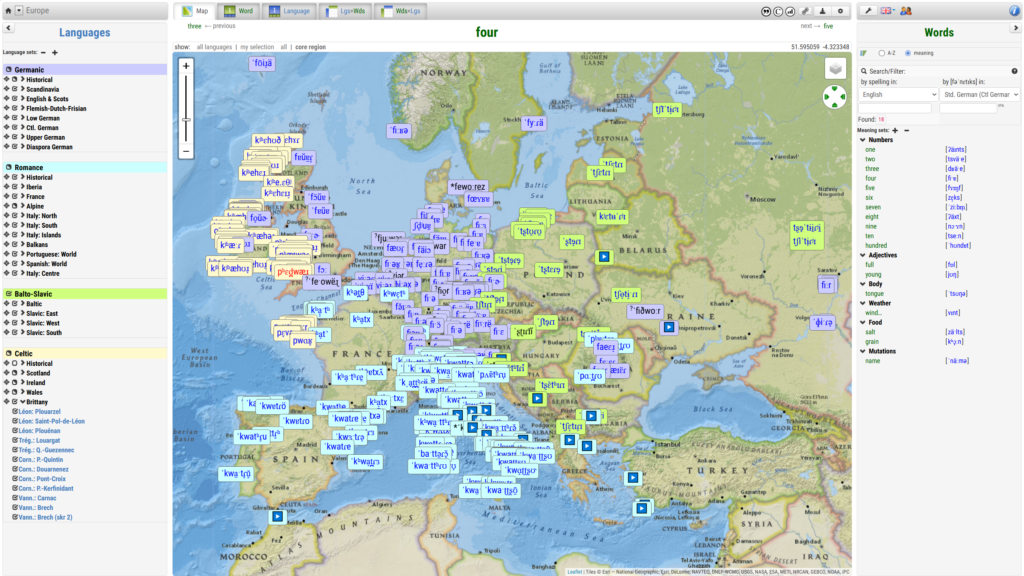
Sound Comparisons: Europe

Sound Comparisons: Europe

Listen to and explore how the ‘same’ basic words are pronounced so differently in hundreds of regional languages, ‘dialects’ and accents across Europe, and some of their far-flung diaspora forms across the world, recorded in over twenty years of fieldwork.
Indo-European

Indo-European

Older than we thought? Bayesian phylogenetic analysis of a new database of the world’s largest language family traces its origins back up to eight millennia, in a new scenario for Eurasia’s prehistory, more coherent with archaeology and ancient DNA.

The Languages of Europe — and of Half the World

Europe is home to a dazzling array of different national and regional languages.  Yet however complex this panorama may seem at close detail, zoom out and it fast resolves into a strikingly straightforward ‘big picture’.  Europe’s history and origins can be framed above all in terms of just four great language lineages that have spread in succession across it, over the past few thousand years, as spoken by Celts, Romans, ‘Germans’ and Slavs.
And against this ‘big four’ background, the exceptions too fit into their own, diverse places:  whether unrelated forerunners (e.g. Basque) or latecomers (e.g. Hungarian);  or indeed sister lineages (like Greek and Albanian), but which did not spread so spectacularly or durably.
Further back in time, the big four lineages, and almost (but not quite!) all other languages in Europe, trace back to the same single source.  So too, moreover, do hundreds more languages, from Armenian to Kurdish, and across Iran, Central and South Asia, as far as Bengal.  All are unexpected cousins of Europe’s languages, and together they form ‘Indo-European’, the world’s undisputed biggest family of languages, spoken by half of the world today.
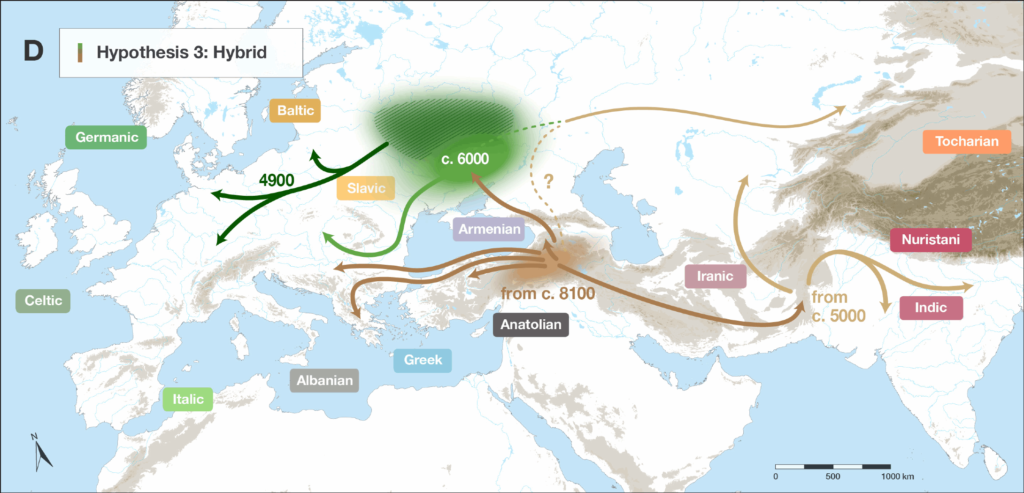
Quite where their Proto-Indo-European ancestor language was originally spoken, however, and when and how its first branches spread so far afield, remain hotly debated enigmas of deep prehistory:  this is ‘the Indo-European question’.  Competing hypotheses emerged particularly from archaeology, while the new-found ability to analyse ancient DNA is bringing a revolutionary new perspective from genetics.  And the latest, controversial analyses in linguistics use Bayesian phylogenetic analysis, aiming to establish a broad chronology for Indo-European from the new IE‑CoR database of ‘cognate’ word relationships across 161 languages, ancient and modern, of the Indo-European family (Heggarty et al. 2023).
In most recent history, the languages of Europe’s first powerful nation states have also spread far and wide beyond Europe itself.  Over the last five centuries or so, Spanish and Portuguese, then French and English, have continued changing and diverging, both within Europe and beyond, into what today are starkly different accents.  The European language diaspora has also thrown up, or preserved, a far-flung scatter of minor languages still spoken far from their European ‘homes’:  Pennsylvania ‘Dutch’, the Pomeranian ‘German’ of Wisconsin;  Patagonian Welsh, Nova Scotia Gaelic;  Chabacano Spanish ‘creole’ in the Philippines.  These and many more can all can be heard and compared at Sound Comparisons, alongside a dedicated study on accents of English from around the world https://soundcomparisons.com/Englishes.
ImageLinkPublication Details     [count = 13]TypeAuthor-Date
URL

Anderson, C., Scarborough, M., Jocz, L., Kümmel, M.J., Jügel, T., Irslinger, B., Pooth, R., Liljegren, H., Strand, R.F., Haig, G., Geupel, U., Macak, M., Kim, R.I., Anonby, E., Pronk, T., Belyaev, O., Dewey-Findell, T.K., Boutilier, M., Freiberg, C., Tegethoff, R., Serangeli, M., Stronski, K., Falileyev, A., Liosis, N., Schulte, K., Gupta, G.K., Izadifar, R., Markus, P., Williams, N., Loi, S., Sims-Williams, N., Findell, M., Adibifar, S., Abete, G., Atanasov, P., Baiwir, E., Bastardas, M.-R., Benkato, A., Bevevino, L.S., Buchi, É., Cadorini, G., Cathcart, C., Cheveau, L., Christodoulou, C., Delorme, J., Dworkin, S.N., Ekici, D., Farridnejad, S., Gheitasi, M., Hammarström, H., Hewitt, S., Khan, A.A., Khan, M.K., Khokhlova, L., Kim, D., Lewin, C., Lushaj, B., Mahmoudveysi, P., Mahommadirad, M., Mersch, S., Mustafa, B., Nemati, F., Nourzaei, M., Muircheartaigh, P.Ó., Oogjen, V., Ourang, M., Pagan, H., Palmer, T.S., Pepper, S., Purandare, M., Rehman, K., Rhys, G., Røyneland, U., Sagar, M.Z., Sandstedt, J.J., Steensland, L., Taheri-Ardali, M., Talebi-Dastenaei, M., Tittel, S., Tresoldi, T., de Vaan, M., Verkerk, A., Versloot, A., Videsott, P., Vuletic, N., Widmer, M., Zeini, A., Bibiko, H.-J., Runge, F., Gray, R.D., & Heggarty, P. 2025.
The Indo-European Cognate Relationships dataset.
Scientific Data 12 (1): p.1541.
https://www.nature.com/articles/s41597-025-05445-3

Journal Article
URL

Heggarty, P., Anderson, C., Scarborough, M., King, B., Bouckaert, R., Jocz, L., Kümmel, M.J., Jügel, T., Irslinger, B., Pooth, R., Liljegren, H., Strand, R.F., Haig, G., Macák, M., Kim, R.I., Anonby, E., Pronk, T., Belyaev, O., Dewey-Findell, T.K., Boutilier, M., Freiberg, C., Tegethoff, R., Serangeli, M., Liosis, N., Stronski, K., Schulte, K., Gupta, G.K., Haak, W., Krause, J., Atkinson, Q.D., Greenhill, S.J., Kühnert, D., & Gray, R.D. 2023.
Language trees with sampled ancestors support a hybrid model for the origin of Indo-European languages.
Science 381 (6656): p.414, eabg0818.
https://www.science.org/doi/10.1126/science.abg0818

Journal Article
URL

Heggarty, P. 2022.
Redefining Indo-European origins? eLetter commentary on: Lazaridis et al. 2022 ‘The genetic history of the Southern Arc: A bridge between West Asia and Europe’.
Science 377 (6609).
https://doi.org/10.1126/science.abm4247#elettersSection

Journal Article
URL

Heggarty, P. 2021.
Cognacy databases and phylogenetic research on Indo-European.
Annual Review of Linguistics 7: p.371–94.
https://doi.org/10.1146/annurev-linguistics-011619-030507

Journal Article
URL

Heggarty, P. 2018a.
Why Indo-European? Clarifying cross-disciplinary misconceptions on farming vs. pastoralism.
in: Kroonen, G., J.P. Mallory, & B. Comrie (eds)
Talking Neolithic: Proceedings of the workshop on Indo-European origins held at the Max Planck Institute for Evolutionary Anthropology, Leipzig, December 2-3, 2013, Journal of Indo-European Studies Monograph Series, p.69–119.
Journal of Indo-European Studies.
http://jies.org/DOCS/monojpgs/Mon65.html

Book Section
URL

Heggarty, P. 2018b.
Indo-European and the Ancient DNA Revolution.
in: Kroonen, G., J.P. Mallory, & B. Comrie (eds)
Talking Neolithic: Proceedings of the workshop on Indo-European origins held at the Max Planck Institute for Evolutionary Anthropology, Leipzig, December 2-3, 2013, Journal of Indo-European Studies Monograph Series, p.120–73.
Journal of Indo-European Studies.
http://jies.org/DOCS/monojpgs/Mon65.html

Book Section
URL

Heggarty, P. 2018c.
Wer waren die Ur-Indoeuropäer? [= Who Were the Indo-Europeans?].
Spektrum der Wissenschaft 2018 (Spezial Archäologie-Geschichte-Kultur 4/2018): p.42–7.
https://spektrum.de/alias/1611302

Journal Article
URL

Heggarty, P., & Renfrew, C. 2014g.
Western and Central Asia: Languages.
in: Renfrew, C. & P. Bahn (eds)
The Cambridge World Prehistory, p.1678–99.
Cambridge: Cambridge University Press.
https://doi.org/10.1017/CHO9781139017831.101

Book Section
URL

Heggarty, P., & Renfrew, C. 2014h.
Europe and the Mediterranean: Languages.
in: Renfrew, C. & P. Bahn (eds)
The Cambridge World Prehistory, p.1977–93.
Cambridge: Cambridge University Press.
https://doi.org/10.1017/CHO9781139017831.115

Book Section
URL

Heggarty, P. 2014a.
Prehistory by Bayesian phylogenetics? The state of the art on Indo-European origins.
Antiquity 88 (340): p.566–77.
https://doi.org/10.1017/S0003598X00101188

Journal Article
URL

Heggarty, P. 2014c.
Das Rätsel der großen Sprachfamilien [= The Puzzle of the great language families].
Spektrum der Wissenschaft 2014 (08): p.70–6.
https://spektrum.de/alias/1298019

Journal Article
URL

Heggarty, P. 2013a.
Europe and Western Asia: Indo-European linguistic history.
in: Ness, I. & P. Bellwood (eds)
The Encyclopedia of Global Human Migration, p.157–67.
Oxford: Wiley-Blackwell.
https://doi.org/10.1002/9781444351071.wbeghm819

Book Section
-

Heggarty, P. 1994.
A Framework for the Systematic Comparison of Indo-European Languages.
. M.Phil. Dissertation. University of Cambridge.

Thesis